
 Dribbble


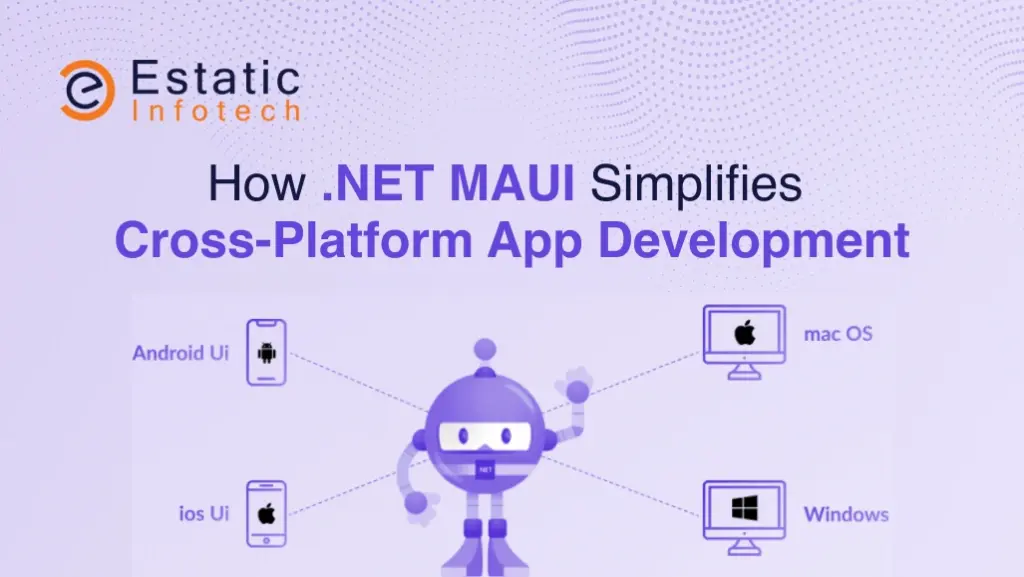
Building applications for Android, iOS, and desktop platforms can require significant development and maintenance effort when each platform is handled separately. .NET MAUI (Multi-platform App UI) provides a modern alternative by allowing businesses to build cross-platform applications using a shared C# and .NET codebase.
For organizations already using Microsoft technologies, .NET MAUI can help reduce duplicated development work while still providing access to native platform capabilities.
But how does .NET MAUI work, and is it the right choice for your application?
What Is .NET MAUI?
.NET MAUI is Microsoft’s cross-platform framework for building native applications with C# and .NET. It evolved from Xamarin.Forms and supports application development for Android, iOS, Windows, and macOS.
Developers can share business logic, UI components, services, resources, and API integrations across platforms while implementing platform-specific functionality when required.
This makes .NET MAUI an attractive option for businesses looking for efficient cross-platform app development without maintaining completely separate applications.
How Does .NET MAUI Simplify App Development?
The biggest advantage of .NET MAUI is its ability to maximize code reuse.
A shared project can contain:
- Business logic
- Data models
- API integrations
- Services
- UI components
- Resources
- Application workflows
Developers can use C# and XAML to build application functionality and interfaces while accessing native APIs when platform-specific features are needed.
Single-Project Architecture
.NET MAUI’s single-project structure simplifies project organization, resources, configuration, and platform targeting.
Instead of maintaining completely separate projects for every platform, teams can manage much of the application from a unified codebase.
This can help reduce development duplication and make future updates easier to manage.
Key Benefits of .NET MAUI
Shared Codebase
Common functionality such as authentication, API communication, validation, business logic, and data management can often be shared across platforms.
This can reduce duplicated development effort and make feature updates more efficient.
Faster Development
Developers can implement common functionality once and make it available across supported platforms. This can be particularly useful for startups and businesses working with limited development resources.
If you are planning a new mobile product, EIPL’s mobile app development services can help you evaluate whether .NET MAUI is the right technology for your requirements.
Native Platform Capabilities
Cross-platform development does not mean giving up access to native functionality. MAUI applications can integrate features such as:
- Camera
- GPS
- Bluetooth
- Biometrics
- Sensors
- Push Notifications
- Device Storage
Platform-specific code can be isolated where necessary without compromising the shared application architecture.
Microsoft Ecosystem Compatibility
.NET MAUI is particularly useful for businesses already working with:
- C#
- .NET
- ASP.NET Core
- Azure
- SQL Server
- REST APIs
- Entity Framework
Existing .NET teams can extend their expertise into mobile and desktop application development without adopting an entirely different technology ecosystem.
.NET MAUI Architecture
A scalable MAUI application should separate different responsibilities instead of placing everything inside the UI layer.
A typical architecture includes:
Presentation Layer: Handles screens, navigation, UI components, and user interaction.
Business Layer: Contains business rules, validation, workflows, and application logic.
Data Layer: Manages APIs, databases, authentication, caching, and synchronization.
Platform Layer: Contains Android, iOS, Windows, or macOS-specific implementations.
MVVM is also commonly used to separate presentation logic from the UI.
A well-planned architecture makes applications easier to test, maintain, and scale. If your project requires broader custom software development, architecture can also be designed around your existing backend and business systems.
.NET MAUI vs Native App Development
The choice between .NET MAUI and native development depends on the application’s requirements.
Native development provides maximum control over individual platforms, but maintaining separate Android and iOS applications can increase development effort.
.NET MAUI can be a strong option when:
- Multiple platforms are required
- Significant functionality can be shared
- The organization already uses .NET
- Faster development is important
- Mobile and desktop applications are required
Native development may be preferable for applications that depend heavily on specialized platform capabilities or require extensive platform-specific optimization.
For businesses unsure which approach is suitable, a technical assessment before development can help avoid costly architectural changes.
When Should Businesses Choose .NET MAUI?
.NET MAUI can support many types of applications, including:
- Enterprise: Workforce management, inventory, field-service, and internal applications
- Retail: Product catalogs, orders, loyalty, and customer applications
- Healthcare: Patient applications, appointments, and wellness platforms
- Logistics: Driver applications, delivery management, and shipment tracking
- Fitness: Activity tracking, dashboards, wearable integrations, and wellness applications
- SaaS: Mobile and desktop applications connected to existing cloud platforms
The framework is especially worth considering when the same core functionality is required across multiple platforms.

Xamarin to .NET MAUI Migration
Businesses with existing Xamarin applications can consider .NET MAUI as part of their modernization strategy.
Migration may involve:
- Updating project structures
- Migrating dependencies
- Replacing deprecated components
- Updating APIs
- Reviewing platform-specific code
- Updating third-party libraries
- Testing application functionality
Migration is not always a simple project conversion. Older applications with significant technical debt may benefit from partial rebuilding or architectural improvements.
If you have an existing Xamarin application, EIPL can evaluate the codebase and create a practical Xamarin migration strategy based on your application’s architecture and business requirements.
How Much Does .NET MAUI Development Cost?
There is no fixed price for .NET MAUI development. Cost depends on:
- Application complexity
- Number of platforms
- UI/UX requirements
- Backend integrations
- Third-party services
- Native device features
- Testing requirements
- Development team size
A simple API-based application will require considerably less effort than an enterprise application involving payments, real-time communication, offline synchronization, or hardware integrations.
For businesses planning a new product, defining the features and platforms before development makes it easier to prepare a realistic budget.

Best Practices for .NET MAUI Development
Successful MAUI applications require more than shared code. Development teams should:
- Use a clean and scalable architecture
- Separate UI, business, and data logic
- Maximize code reuse without forcing platform differences into shared code
- Optimize startup and memory usage
- Design for offline scenarios where necessary
- Test on real Android and iOS devices
- Keep dependencies updated
- Plan deployment and CI/CD early
Cross-platform development can reduce duplication, but platform-specific testing and optimization remain essential.
How to Choose a .NET MAUI Development Partner
When choosing a development partner, evaluate more than pricing. Look for experience with:
- C# and .NET
- .NET MAUI
- Android and iOS development
- Mobile architecture
- APIs and cloud integration
- Native platform features
- Testing and deployment
- Xamarin migration
A capable partner should understand both the technology and the business objectives behind your application.
Businesses looking for dedicated expertise can also explore EIPL’s app development services or discuss requirements for hiring experienced .NET MAUI developers.
Why Choose EIPL for .NET MAUI Development?
Estatic Infotech helps businesses build and modernize applications using modern .NET technologies.
Our team can support:
- New .NET MAUI applications
- Cross-platform development
- Xamarin-to-.NET MAUI modernization
- API and backend integration
- Native platform integrations
- Application testing
- Maintenance and support
Whether you are starting a new application or modernizing an existing product, EIPL can help define the technology, architecture, development approach, and long-term roadmap.
Frequently Asked Questions
Is .NET MAUI suitable for business applications?
Yes. It can be used for enterprise, retail, healthcare, logistics, fitness, SaaS, and other business applications.
Can .NET MAUI build Android and iOS applications?
Yes. A shared MAUI project can target both Android and iOS while allowing platform-specific implementations when required.
Can Xamarin applications be migrated to .NET MAUI?
Yes. Xamarin and Xamarin.Forms applications can be candidates for migration, although the effort depends on architecture, dependencies, third-party libraries, and existing platform-specific code.
Is .NET MAUI better than Flutter or React Native?
There is no universal answer. .NET MAUI can be particularly suitable for organizations already using C# and .NET, while Flutter or React Native may be better suited to teams using Dart or JavaScript/TypeScript.
How much does .NET MAUI development cost?
The cost depends on application complexity, features, platforms, integrations, design, testing, and development resources. A project assessment is required for an accurate estimate.
Conclusion
.NET MAUI provides businesses with an efficient approach to cross-platform application development by combining shared C# and .NET code with native platform capabilities.
It can help reduce duplicated development effort, simplify maintenance, and support applications across mobile and desktop platforms. However, the right architecture, testing strategy, platform requirements, and long-term maintenance plan should be considered before development begins.
Whether you are building a new application, expanding an existing product to mobile, or migrating from Xamarin, EIPL can help you plan and execute the right solution.