
 Dribbble


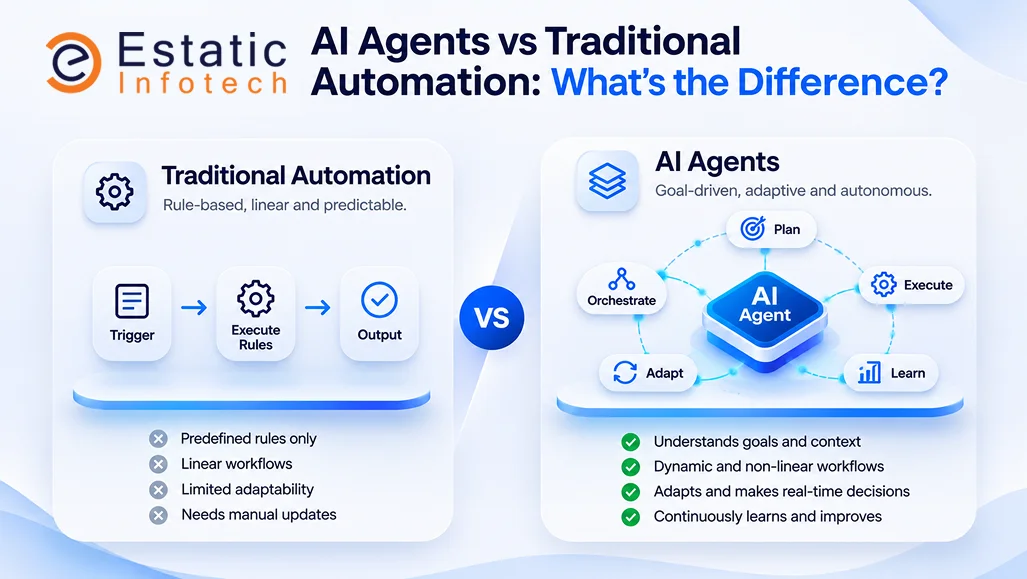
Most operations managers spend half their week fixing broken Zapier connections.
You set up a simple trigger to move email attachments into a Google Drive folder. A vendor changes their invoice format from PDF to a JPEG. The zap fails. The automation halts. You spend 3 hours digging through error logs to figure out why your accounting pipeline died.
Rule-based automation is incredibly rigid. If the input deviates by a single pixel or a single character, the machine stops working.
Building a resilient backend requires a custom software development approach that integrates autonomous reasoning. You need software that thinks. AI agents look at the broken JPEG invoice, realize it is just a picture of text, run it through vision processing, extract the data, and put it in the database anyway. They fix their own errors.
Let us break down exactly how these autonomous systems are replacing old scripts and where you should deploy them.
The brittle reality of rule-based scripts
Companies spent millions over the last decade buying robotic process automation (RPA) licenses.
They recorded their employees clicking specific coordinates on a screen and told a bot to repeat those clicks 5,000 times a day. Then the IT department updates the accounting software. The "Submit" button moves 4 pixels to the left. The RPA bot clicks empty space and fails 5,000 times. You have to hire a consultant to re-record the screen.
When you evaluate AI agents vs traditional automation software, you have to factor in this maintenance tax. Traditional automation assumes a perfect world. The real world is extremely messy. APIs change endpoints. Data arrives poorly formatted. Rule-based tools require a human to map every possible failure state in advance. Nobody running a real business has time for that.
How autonomous systems actually operate
Agents have actual agency. They operate on a loop of observing, planning, and acting.
Give an agent a goal to reconcile 400 shipping manifests against bank records. The agent logs into the shipping portal. It notices the layout changed. It reads the HTML DOM to find the new download link. It downloads the files. If a file is password protected, it searches the company knowledge base for vendor passwords, tries them, unlocks the file, and continues working.
That level of reasoning explains why operations teams are scrambling to implement agentic ai in enterprise environments. The software adapts to the environment. You give it a target. The agent figures out the execution path completely on its own.
Finding the best AI agent platforms compared with rule-based automation tools
You probably want specific software names that actually work in production.
Zapier and Make dominated the rule-based era. They are still great for fixed workflows. If you need a lead from a Facebook ad pushed into a Mailchimp list, use Make. It takes 4 minutes to build and runs perfectly.
Agentic logic requires a different stack. Tools like CrewAI or AutoGPT allow you to spin up multiple specialized agents that talk to each other. You create a "Research Agent" and a "Summary Agent". The first one scours the internet for competitor pricing. It passes the raw unstructured data to the second one. The second one formats a clean report and emails it to your CEO.
If you try to build that complex reasoning loop in Zapier, you end up writing massive Python code blocks inside webhooks. It gets incredibly messy very fast.
Which automation platform supports AI agents and fixed workflows?
Most mid-sized companies cannot rip out their existing RPA infrastructure overnight. They need hybrid platforms.
UiPath recognized this massive market shift early. They bolted agentic capabilities onto their legacy RPA platform with UiPath Autopilot. It lets a human type a plain text command to generate a complex automation workflow that interacts with legacy desktop software.
Microsoft is quietly taking over the enterprise space with Copilot Studio. You can build an agent that lives inside Microsoft Teams. It has access to your SharePoint files, your Outlook calendar, and your Dynamics CRM data. You can tell it to pull all the sales data for Q3, format it into a chart, and send it to the board.
This hybrid approach defines a modern AI automation platform with agent and RPA features. You keep the strict security controls of fixed APIs while letting the agent handle the unstructured edge cases.
Workflow tools for heavy business processes
Customer support is the most obvious target for AI agent workflow automation tools for business processes.
Old chatbots were just glorified decision trees. A customer types "refund". The bot spits out a link to the refund policy. The customer gets angry and demands a human operator.
An agentic support system acts like a real employee. A customer asks for a refund. The agent checks the purchase date in Shopify. It checks the FedEx tracking status. It sees the package was marked delivered 2 days ago. It authorizes a return label via the Shippo API, emails it to the customer, and tags the Zendesk ticket as resolved.
Seeing how businesses can use generative ai to close out support tickets automatically changes the entire profit margin of an e-commerce company. It handles the entire business process without waking up your support manager.
Compare AI agents, RPA, and workflow automation software
We need to segment these clearly so you stop buying the wrong licenses.
RPA mimics human clicks. You use it in legacy environments where modern APIs simply do not exist. Think 30-year-old banking mainframes running on terminal emulators. You use RPA because you literally have no other choice.
Workflow automation software moves data between modern cloud apps via APIs. It is fast, cheap, and reliable as long as the data is structured perfectly.
AI agents are digital workers. They handle unstructured inputs. They read emails, listen to voicemails, and look at images. They make logical jumps that would instantly break a standard API script.
You use all 3 in a mature company. You use RPA to scrape the legacy database. You use Zapier to push that data into an agent's memory bank. You use the agent to analyze the data and make a financial decision.
Integrating physical devices and mobile platforms
Agents operate far beyond web browsers. They are bleeding directly into physical hardware.
If you run a logistics company, you have sensors on your delivery trucks. A standard rule says that if the truck temperature goes above 40 degrees, the system sends a text alert.
When you hire an iot app developer to wire an AI agent into that sensor network, the response changes entirely. The agent sees the temperature spike. It checks the traffic API. It sees the truck is stuck in a 2-hour traffic jam. It automatically reroutes the truck to the nearest cold-storage facility and texts the client about the delay.
This logic extends straight to the phone in your pocket. Look at how ai is improving mobile applications. A mobile agent can observe your location, your calendar, and your battery life, then proactively suggest you call an Uber before your phone dies.
The cost of maintaining dumb software
Founders love buying cheap SaaS tools. They hate calculating the maintenance cost of those tools.
If you have 400 active Zapier automations, you probably have a full-time operations person whose entire job is fixing broken connections. That is a $70,000 salary paying for someone to manage dumb software.
Replacing those brittle connections with autonomous agents reduces your operational headcount. The software heals itself. When an API endpoint changes, the agent reads the new API documentation, rewrites its own payload, and tries again.
This level of self-correction shows how generative ai is changing software development. We are moving away from writing explicit instructions. We are moving toward defining operational boundaries and letting the machine figure out the execution.
Automating the mess of human resources
Employee onboarding is a logistical nightmare for scaling companies.
A new hire signs an offer letter. HR has to provision a Google Workspace account, order a laptop, add them to Slack, enroll them in payroll, and assign 5 training modules. Traditional workflow tools handle this by firing off 15 different API calls the second the contract gets signed.
It works fine until the new hire puts a typo in their email address. The API calls fail. The IT guy has to manually provision everything on a Friday afternoon.
An onboarding AI agent catches the typo automatically. It cross-references the employee's name with the applicant tracking system. It figures out the correct email format for the company. It provisions the accounts correctly. If the payroll API is down for maintenance, the agent waits 2 hours and tries again instead of throwing a fatal error. It absorbs human error without breaking the operational chain.
Financial reconciliation and unstructured data
Accounting departments spend weeks manually matching bank statements against vendor invoices. The data is entirely unstructured. Vendors send PDFs, blurry cell phone pictures of receipts, and random line items buried in email threads.
RPA bots cannot read a blurry receipt. They require structured OCR templates. If the vendor moves the "Total Amount" field down 2 inches, the template breaks instantly.
Agentic systems use multi-modal vision models. The agent looks at the image of the receipt exactly like a human accountant would. It spots the total amount, identifies the date, and extracts the vendor name. It logs into QuickBooks and reconciles the expense against the corporate card feed. If the receipt is missing a date, the agent replies to the vendor's email asking for clarification. It handles the edge case asynchronously.
The true cost of compute vs fixed subscriptions
When you buy workflow software, you pay for a fixed number of tasks. The cost is highly predictable. The finance team loves predictability.
Agentic AI completely ruins that pricing model. You pay for compute. You pay for API tokens.
If an agent encounters a strange edge case, it might run 15 recursive loops trying to solve the problem. It queries the database, reads an error, rewrites its code, queries again, searches the web, reads a PDF, and summarizes it. That single task just consumed 45,000 input tokens and 12,000 output tokens.
If you deploy an inefficient agent into a high-volume production environment, your API bill will explode overnight. You have to optimize agent prompts aggressively. You cache common database queries. You route simple tasks to cheaper models and only wake up the expensive reasoning models for complex logic failures.
Security and audit trails for autonomous systems
When a human makes a mistake, you can ask them why they did it. When a traditional automation script fails, you pull the error log and see exactly which line of code threw the exception.
When an AI agent makes a mistake, debugging gets weird. You are dealing with a black box of probabilistic token generation. If an agent approves a fraudulent $10,000 invoice, you need to know exactly how it reached that conclusion.
You must build aggressive observability into your agentic platforms. Every time the agent makes an API call, you log the exact prompt it sent to the LLM, the exact JSON response it received, and the reasoning trace it generated. Platforms like LangSmith or Phoenix allow engineering teams to track these agent trajectories. You use that log to rewrite the system prompt and add a new guardrail.
Compliance auditors require hard proof of the execution path. You must log the exact decision tree for every automated action your agents take in production.
Start small and contain the blast radius
Do not give an autonomous agent access to your production database on day one.
Agents hallucinate. They get stuck in infinite loops. They will absolutely try to delete a table if they think it helps them achieve their goal.
You must contain the blast radius. Give the agent read-only access first. Let it analyze data and propose actions. Have a human click "Approve" before the agent can send an email or move money. Once the agent proves it can execute the workflow 100 times without failing, you can remove the human from the loop.
You make a new intern earn trust over weeks of supervision. Treat an AI agent exactly the same way.